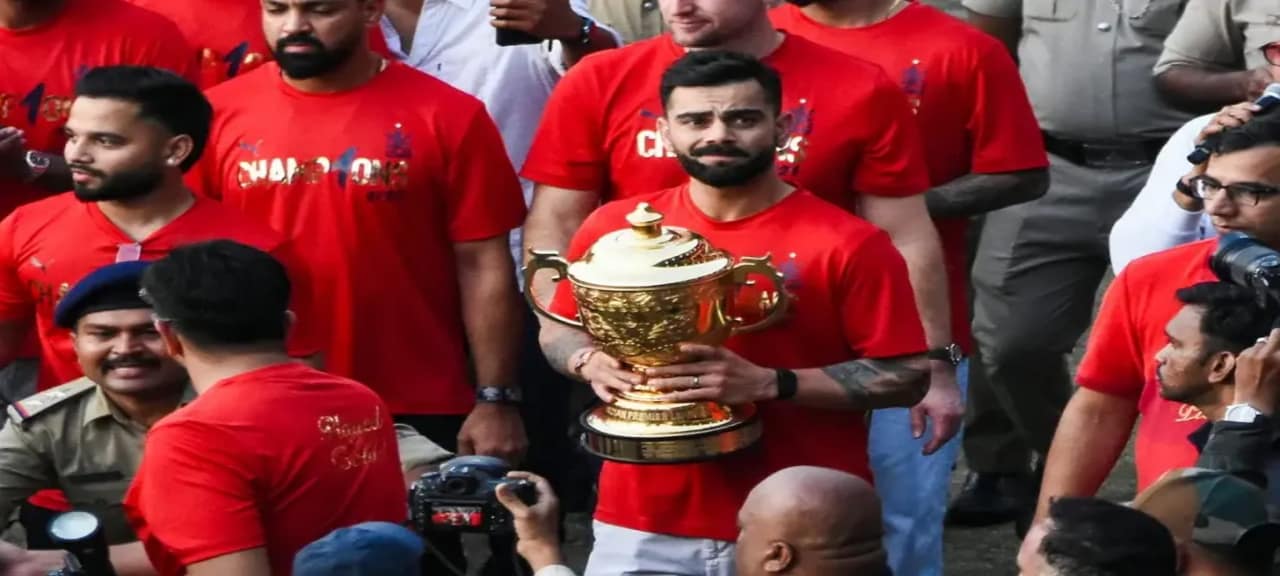
American investors have made history in Indian cricket — twice in a single day. Rajasthan Royals and Royal Challengers Bangalore have crossed the $1 billion mark, signaling global confidence in the IPL and India’s cricket boom.
“It’s mind-boggling numbers… but great news for Indian cricket,” said Sourav Ganguly, India’s cricketing legend.
The deals mark a seismic shift from 2008, when RCB and Rajasthan Royals were sold for mere $111.6 million and $67 million, respectively.
⚡ Fast Facts
- RCB sold for: $1.78 billion
- Rajasthan Royals sold for: $1.63 billion
- Key U.S. investors involved: David Blitzer, Rob Walton, Kal Somani, Blackstone
- IPL broadcast rights (2023-27): $6.4 billion
- RCB’s first IPL title: 2025
Quick Gist
- Two IPL franchises crossed $1B in sales on the same day.
- Deals reflect global interest in India’s cricket market.
- IPL is now compared to NBA in terms of commercial appeal.
- New ownership teams will revamp management and strategic direction.
What Happened
In a historic day for Indian cricket, Rajasthan Royals was acquired by a U.S. consortium led by Kal Somani and Rob Walton for $1.63 billion, while Royal Challengers Bangalore went to David Blitzer’s Bolt Ventures and Blackstone for $1.78 billion.
These deals shattered the billion-dollar ceiling that no IPL team had crossed before. The transactions also highlight the IPL’s meteoric rise as a global sporting powerhouse, attracting investors across continents.
| Team | Sale Price | Key Investors | Original 2008 Price |
|---|---|---|---|
| RCB | $1.78B | David Blitzer, Blackstone | $111.6M |
| Rajasthan Royals | $1.63B | Kal Somani, Rob Walton | $67M |
Why It Matters
The IPL’s appeal to international investors is skyrocketing. The league now rivals top global sports in terms of commercial scale. The 2023-27 broadcast rights alone fetched $6.4 billion, underscoring IPL’s massive media value.
Sourav Ganguly called it a “mind-boggling” sign of growth, while Kumar Mangalam Birla emphasized the global platform RCB now represents.
“RCB offers a distinctive platform to extend our legacy into global sport,” Birla said.
Must Read: Gautam Gambhir Just Won a Legal Battle — Here’s Why It Matters
Industry & Market Impact
- Sports franchises are increasingly prime assets for global investors.
- Private equity deals in sports have surged in recent years.
- IPL’s 3-month T20 format maximizes fan engagement and revenue potential.
- Comparatively, London Spirit in England’s The Hundred is valued at $370 million.
Insight: The IPL is outperforming many international leagues in terms of both valuation and investor enthusiasm.
Expert Opinions
- Blitzer: “One of the great growth stories in global sport.”
- Sourav Ganguly: “Great news for Indian cricket.”
- Deloitte analysts: Sports leagues are entering an “age of expansion,” with private equity deals climbing sharply.
Contrarian View
Some analysts caution that skyrocketing valuations could create long-term sustainability risks if revenue growth slows. Others question whether fan culture can keep pace with corporate ownership.
What Happens Next
- New management teams will lead strategic direction:
- RCB: Aryaman Vikram Birla as chairman, Satyan Gajwani as vice-chairman.
- Rajasthan Royals: Kal Somani taking full control pending BCCI approval.
- Focus will shift to global brand expansion, fan engagement, and revenue diversification.
- Observers will watch how U.S. investors leverage IPL’s T20 format for international growth.
🔍 FAQs
Q1: Why did IPL teams sell for over $1 billion in 2026?
A: High global interest, massive media rights, and T20’s explosive popularity drove the valuations.
Q2: How does this compare to previous IPL sales?
A: RCB and Rajasthan Royals sold for $111.6M and $67M in 2008, marking a 15x+ increase in 18 years.
Q3: What should fans watch next?
A: Team management changes, international marketing strategies, and IPL 2026 season performance under new ownership.
Editorial Disclaimer
This article provides analysis based on publicly available information. All facts are derived from verified reports. No events or outcomes have been fabricated.