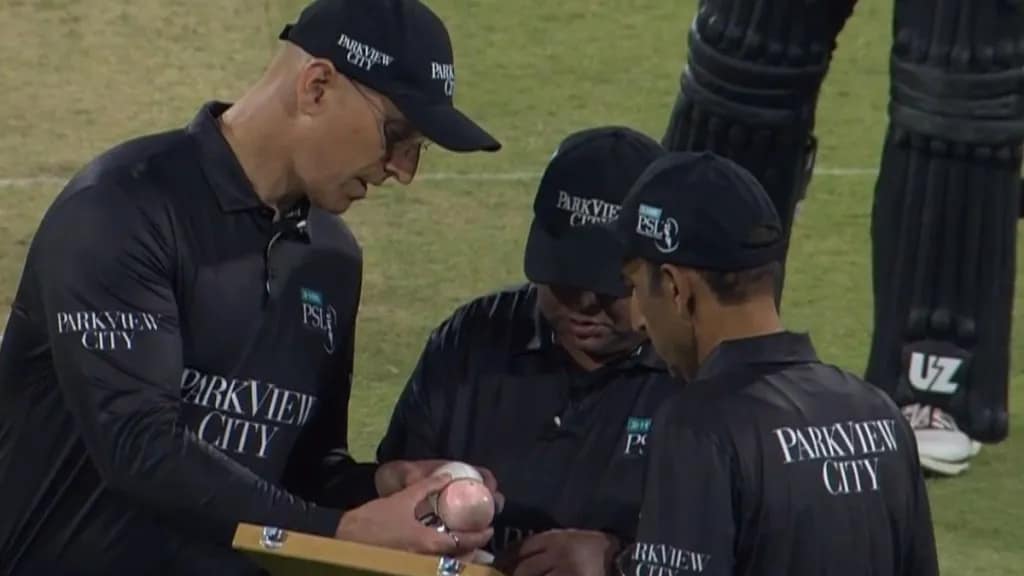
“After the second over… the ball is red.” That blunt admission from Marnus Labuschagne has triggered one of the strangest controversies in Pakistan Super League history — a white ball turning pink mid-match.
And no, this wasn’t planned.
Table of Contents
Toggle⚡ Fast Facts
- Match: Lahore Qalandars vs Hyderabad Kingsmen
- Issue: White ball turned pink due to jersey dye
- Trigger: Labuschagne raised concern early in the innings
- Reaction: Kamran Akmal mocked incident as “dupatta gali” quality
- Outcome: Ball changed mid-game; controversy exploded online
🧠 30-Second Gist
- The PSL 2026 opener turned bizarre when the match ball changed color.
- Labuschagne flagged it immediately to umpires.
- Dye from Kingsmen jerseys reportedly caused discoloration.
- Kamran Akmal’s sarcastic take added fuel to viral debate.
- The franchise later joked about a “pink-ball game” on social media.
🚨 What Happened — And Why It’s Raising Eyebrows
The PSL 2026 opener was supposed to be routine.
Instead, it turned into a viral spectacle.
Just two overs into the game, Labuschagne noticed something was off — the white ball was no longer white. It had visibly turned pink.
His immediate reaction?
“What’s happening? The ball is red.”
Umpires were alerted, and the issue quickly became impossible to ignore.
The suspected culprit: dye from Hyderabad Kingsmen’s jerseys rubbing off onto the ball.
That forced an unusual mid-innings ball change — something rarely seen for this reason.
🤯 Why This Matters More Than It Looks
At first glance, it feels like a harmless, even funny glitch.
But this raises deeper concerns:
- Equipment standards: Are franchise kits being properly tested?
- Match integrity: Could altered ball conditions affect gameplay?
- League reputation: PSL’s global credibility is under scrutiny
📊 Key Concern Snapshot
| Issue Area | Risk Level |
|---|---|
| Ball Condition | High |
| Player Fairness | Medium |
| League Image | High |
Even Labuschagne admitted he had never seen anything like this before — not from bats, pads, or any equipment.
🎙️ What Experts (and Critics) Are Saying
This is where things got spicy.
Kamran Akmal didn’t hold back — and his comment instantly went viral:
“Each city has a dupatta gali… the kits seem like they’ve just come from there.”
He even joked that the discoloration might be due to traditional dyeing methods.
At first, he thought it was a camera issue.
It wasn’t.
Must Read: IPL 2026 Starts Before First Ball — Here’s Why It Matters
🔄 But Here’s the Twist…
The Hyderabad Kingsmen didn’t get defensive.
Instead, they leaned into the chaos.
After losing the match, they posted a cheeky message:
“Congratulations to the opposition on winning their first pink-ball game.”
That one line turned outrage into meme culture within minutes.
⚖️ Contrarian View — Is This Being Overblown?
Not everyone sees this as a major issue.
Some argue:
- Ball discoloration happens occasionally from external contact
- No evidence suggests deliberate tampering
- The issue was quickly corrected during the match
In that sense, this could be more viral moment than serious failure.
Still, the optics? Not great.
🔍 What Happens Next — And Why Fans Should Watch Closely
Labuschagne expects action.
“I’m sure they’ll fix it in the upcoming games.”
That puts pressure on:
- Franchise kit manufacturers
- PSL organizers
- Match officials
👀 Watch for These Developments
- Possible kit material changes
- Stricter pre-match equipment checks
- Official PSL clarification
Because if this happens again?
It won’t just be funny — it’ll be damaging.
❓ FAQs
Why did the PSL 2026 ball turn pink?
The white ball reportedly changed color due to dye from Hyderabad Kingsmen’s jerseys transferring onto it during play.
Did the pink ball affect the match outcome?
There’s no confirmed impact on the result, but the ball was changed mid-game to maintain fairness.
What did Kamran Akmal say about the controversy?
He mocked the situation, comparing the jerseys to those dyed in “dupatta gali,” suggesting poor-quality coloring.
📌 Editorial Disclaimer
This article is an analytical rewrite based entirely on the provided source material. All facts, quotes, and events are preserved without alteration or fabrication. Interpretations are included for contextual clarity and reader engagement.